
Wednesday, July 25, 2007
Heatwave
CNN and the like are reporting 500 dead in Hungary due to the heatwave. Temps in some places have been up to 40 degrees C but overall things are OK here. I am surprised by those figures. It's hot, but overall it seems OK. Anyway, just wanted to tell you all that we here are fine. Off on a family holiday tomorrow, so I probably won't be blogging for a week or so.


Monday, July 23, 2007
New book sneak preview
I have been talking to those nice people at my Publisher BRADT www.bradtguides.com
The title of my book will be CENTRAL & EASTERN EUROPE: A WILDLIFE GUIDE. The cover will be a full face photo of a Wolf. I wanted a large carnivore on the cover, and it does get much better than a Wolf. Hopefully the editors will find very little to do with my manuscript and the book will be published next summer, less than one year away.
The title of my book will be CENTRAL & EASTERN EUROPE: A WILDLIFE GUIDE. The cover will be a full face photo of a Wolf. I wanted a large carnivore on the cover, and it does get much better than a Wolf. Hopefully the editors will find very little to do with my manuscript and the book will be published next summer, less than one year away.
Friday, July 20, 2007
Green Woodpecker, new bird
Well, not a new bird for me... but a new bird for our garden. A new one for our garden-list (that's yard-list to my US friends!). But why now? It's up in the high 30s C here in Budapest and one calls... giving its famous laugh, the "yaffle", yesterday morning. Green Woodpecker (Picus viridis) one of Europe's most familiar woodpeckers, indeed most familiar birds. A largely terrestrial feeder, with a taste for ants, but a tree-hole nester.
Tuesday, July 17, 2007
Three-toed Woodpecker plumages
Today, I received some photos and a question regarding Three-toed Woodpeckers in southern Germany. It all centres on the following and it's a topic that comes up every year...
There is much individual variation in the plumages of European Three-toed Woodpecker (Picoides tridactylus), especially within the central and southern European populations which are P.t.alpinus (for more on this see "Variation" on page 158 in my book WOODPECKERS OF EUROPE, and the drawings on page 157). I can say that it is not unusual to see birds in the Carpathians, Alps and Balkan ranges that have very white and largely unmarked backs, which is more typical of the more northerly distributed P.t.tridactylus race. A good feature to look for in such birds is the amount of dark (mainly black) markings (barring and flecking) on theunderparts, esp on the flanks and belly. Most of the "white-backed" alpinus show more black barring and flecking here than classic tridactylus birds. Some observers have suggested that white-backed southern birds are tridactylus birds within the range of alpinus. Some observers have even gone as far as to say that "all" birds in this area are white-backed, and therefore tridactylus, and that no birds have barred backs as alpinus are supposed to have. I know this to be view to be wrong. Classic alpinus birds with barred backs do exist. Yet, there is much to prove, and it is not impossible that the odd northern bird wanders southwards each year, but I personally believe that such white-backed birds are the result of extreme local individual variation rather than populations of tridactylus living amongst alpinus.
There is much individual variation in the plumages of European Three-toed Woodpecker (Picoides tridactylus), especially within the central and southern European populations which are P.t.alpinus (for more on this see "Variation" on page 158 in my book WOODPECKERS OF EUROPE, and the drawings on page 157). I can say that it is not unusual to see birds in the Carpathians, Alps and Balkan ranges that have very white and largely unmarked backs, which is more typical of the more northerly distributed P.t.tridactylus race. A good feature to look for in such birds is the amount of dark (mainly black) markings (barring and flecking) on theunderparts, esp on the flanks and belly. Most of the "white-backed" alpinus show more black barring and flecking here than classic tridactylus birds. Some observers have suggested that white-backed southern birds are tridactylus birds within the range of alpinus. Some observers have even gone as far as to say that "all" birds in this area are white-backed, and therefore tridactylus, and that no birds have barred backs as alpinus are supposed to have. I know this to be view to be wrong. Classic alpinus birds with barred backs do exist. Yet, there is much to prove, and it is not impossible that the odd northern bird wanders southwards each year, but I personally believe that such white-backed birds are the result of extreme local individual variation rather than populations of tridactylus living amongst alpinus.
Monday, July 16, 2007
My 2008 tour plans becoming clearer
As you can see it's July 2007, but my 2008 movements are now almost sorted. I will be doing tours in Hungary, of course, both birding, butterfly, general natural history and photography tours for various companies and groups of people. But, at various times of the year, I will also be in Croatia, the Czech Republic, Bulgaria, Estonia and Romania... another busy year in store. And that is good... more birds, more travel, more wildlife, and no doubt many more interesting and colourful characters to meet :-)
Woodpeckers calling, hawkmoth buzzing
Though it is July and summer temps are at a high, (mid-30s C each day now) woodpeckers still call from time to time. I was at Lake Balaton again at the weekend. Great Spotted Woodpeckers were around the gardens and called each morning, a Middle Spotted, possibly two, called from time to time during the day from big oak trees in a neighbour's yard. In the later afternoon we went for an ice-cream at the other end of the village and I heard a Lesser Spotted Woodpecker call from a campsite. At the house there were the usual suspects: Golden Oriole, Spotted Flycatcher, Black Redstart, Song Thrush. The Balkan Wall Lizard was around and also a very active Hummingbird Hawkmoth. This is not the easiest time of year for birding, certainly not for woodland species, but if you keep your ears open even the woodies can be heard... and seen.
Friday, July 13, 2007
Crane Migration in October
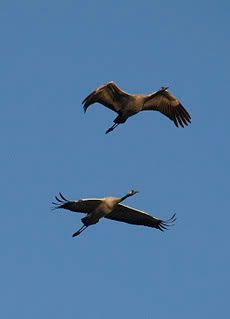
I would just like to remind everybody that I am guiding a special, private, budget-priced tour in Hungary this October (14th - 21 October, 2007). We will stay in the Bukk Hills and on the Hortobagy Plain. There are still some places open on this trip. Get in touch if you think you'd like to join us! It's a bargain and I will be working hard to ensure everything is staked out in advance! Email me and I will send you more info. Highlights will be many, many Common Cranes (up to 80,000 pass through Hungary at this time), plus Great Bustards, Saker Falcon, Eastern Imperial and White-tailed Eagles, Lesser White-fronted and Greater White-fronted Geese, lots of ducks, some shorebirds and 8 species of woodpecker including Black, Grey-headed and White-backed.
Subscribe to:
Posts (Atom)